Why Does Sub-Visible Particulate Testing Matter
Control of particulate contamination helps pharmaceutical manufacturers to:
- Protect patient safety
- Demonstrate compliance with pharmacopoeial specifications
- Monitor product quality throughout its shelf life
- Investigate manufacturing or packaging-related contamination
- Assess the compatibility of formulations with containers and delivery systems
- Identify changes caused by aggregation, precipitation or product degradation
The particles detected may be extrinsic, intrinsic or inherent to the product. Testing counts particles present in the sample but does not, by itself, identify their chemical composition or source.
What is Sub-Visible Particulate Testing?
Sub-visible particulate testing detects and counts particles present in injectable pharmaceutical products that cannot normally be seen with the unaided eye.
Particulate matter may originate from raw materials, manufacturing processes, product–container interactions, component degradation or accidental contamination. Monitoring these particles is an important element of product quality control because injectable products are administered directly into the body.
Butterworth Laboratories provides sub-visible particulate testing in accordance with applicable pharmacopoeial requirements, including:
- USP <787> Subvisible Particulate Matter in Therapeutic Protein Injections
- USP <788> Subvisible Particulate Matter in Injections
- European Pharmacopoeia Chapter 2.9.19, Particulate Contamination: Sub-visible Particles
Analytical Principle
Pharmacopoeial testing generally describes two complementary procedures.
Method 1 – Light Obscuration Particle Count Test
Light obscuration is normally the preferred method. The sample passes through a sensor containing a light beam. Each particle crossing the beam reduces the amount of light reaching the detector, allowing the instrument to determine the particle’s equivalent size and count it. Results are typically reported for particles:
- Equal to or greater than 10 µm
- Equal to or greater than 25 µm
Light obscuration provides rapid, automated particle counting with minimal sample handling. Careful sample preparation is essential because air bubbles may be counted as particles.
Why choose Butterworth Laboratories?
- Experienced Analytical Staff: Our analysts understand potential sources of particle cross-contamination and take steps to minimise environmental interference, helping ensure accurate, reliable results.
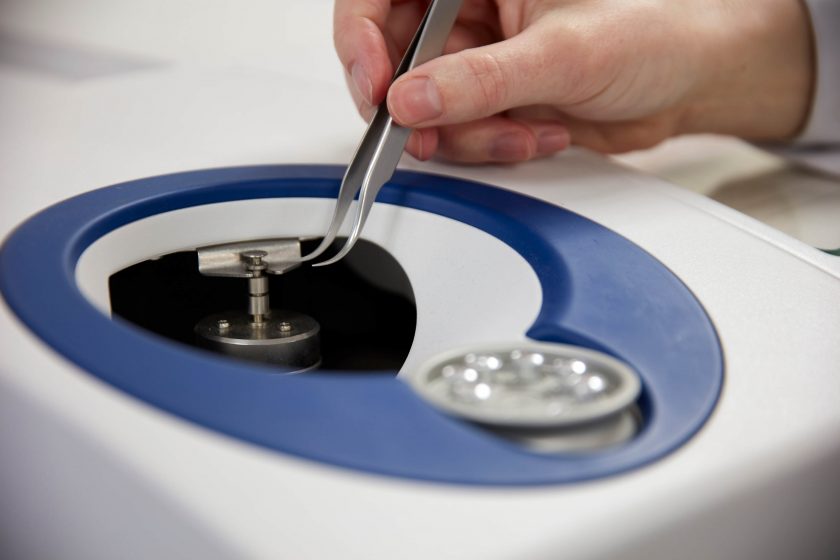
- Well-Maintained Instrumentation: Our APSS-2000 light-obscuration particle counter is maintained and calibrated in accordance with regulatory requirements:
- Rapid Turnaround: Testing can be completed within 24 hours on request – ideal for time-sensitive studies, including monitoring protein stability and aggregate formation.
Frequently Asked Questions
Pharmacopoeial compliance testing normally evaluates the cumulative numbers of particles equal to or greater than 10 µm and 25 µm. Additional size channels may be recorded where supported by the instrument and required by the study protocol.
USP <788> provides general requirements for sub-visible particulate matter in injections. USP <787> is specifically intended for therapeutic protein injections and includes provisions designed to accommodate their product characteristics and frequently limited sample volumes.
Light obscuration is generally the preferred pharmacopoeial method. Microscopic particle counting may be used where the product is unsuitable for light obscuration or where the applicable chapter requires an alternative or confirmatory test.
No. Pharmacopoeial particulate testing determines particle numbers and sizes but does not normally identify their composition
Sample requirements depend on the product, fill volume, container presentation, applicable pharmacopoeial chapter and analytical method.