Butterworth Laboratories’ latest article, published on the Pharmaceutical Technology website, explains why the latest guideline is significant in analytical procedure development for pharmaceuticals.
To read the article, click here
For over 40 years, Butterworth Laboratories has provided independent, contract analytical services to the global pharmaceutical and related industries.
by John Welch
Butterworth Laboratories’ latest article, published on the Pharmaceutical Technology website, explains why the latest guideline is significant in analytical procedure development for pharmaceuticals.
To read the article, click here
by John Welch
Come and join us at the JPAG Meeting being held at the Royal Society of Chemistry, Burlington House, London at the JPAG Meeting on 21st March 2024.
Raw materials, APIs and excipients play an important role in the manufacturing of pharmaceutical products therefore it is important to assess and monitor quality of these materials throughout the product lifecycle. This symposium will present an overview of testing and risk assessment of these pharmaceutical product components throughout the life cycle with presentations and a panel discussion covering topics related to our key themes below:
– pharmacopoeial monographs for assessing raw materials
– regulatory perspectives (ICH Q7, ICH Q11) covering aspects for small molecules, biologics and ATMPs
– risk assessment of raw materials
– Good Manufacturing Practice
– physical testing including incoming receipt of API & excipients
– method optimisation and development
– stability of APIs
– supply chain impact & resilience
– sustainability
Speakers:
Dr Ralph Adams – Manchester University & RSC NMR group
Dr Hisham Al-Obaidi – University of Reading School of Pharmacy
Rodrigo Arias – DFE Pharma & IPEC Federation
Iain Moore – EXCiPACT asbl
Richard Smalley – Consultant and QP Assessor
Trevor Watson – MHRA
Michael Whaley – Medicines and Healthcare products Regulatory Agency (MHRA)
Antonia Wierzbicki – Waters
For further details, Click Here
by John Welch
The general challenge posed by the analysis of free amino acids is that many degrade under the high sample injector temperatures required for gas chromatography (GC) analysis. This challenge is further compounded by the fact that while high-performance liquid chromatography (HPLC) procedures can efficiently separate even very complex mixtures of amino acids, the resolved sample components do not absorb UV radiation. This rules out the visualisation and recording of the separation process results using standard UV detectors.
The solution employed by the European Pharmacopoeia (PhEur) historically was to use low-resolution thin layer chromatography (TLC) procedures that first separated the sample amino acids followed by treatment of the TLC plate with ninhydrin reagent, which reacted with the resolved components to give coloured derivatives which could be assessed by simple visual inspection.
From 2013, the TLC method has been being replaced by a post-column derivatisation HPLC procedure, which adds ninhydrin reagent and heat to the mobile phase containing resolved sample components as it exits the analytical column. As with the TLC procedure, this gives coloured derivatives, which can be assessed using UV detection. Thus, when the TLC or HPLC test is prescribed in PhEur monographs, it is called “Ninhydrin-positive substances” (NPS).
Where TLC is prescribed as the ninhydrin-positive substances (NPS) test in individual amino acid monographs, they contain all of the instructions for preparing analytical solutions and mobile phase, TLC plate selection, and detail the entire analytical procedure, in line with the general TLC monograph (2.2.27). The only system suitability demonstration required is a substance monograph-specific, two-component resolution.
When HPLC is prescribed as the NPS test in individual amino acid monographs, these also contain all the instructions for preparing the required analytical solutions. All monographs have the same requirement for the resolution of leucine and isoleucine to demonstrate system suitability. Furthermore, universal HPLC system suitability requirements addressing sensitivity and peak symmetry stipulated in the Chromatographic Separation Techniques general monograph 2.2.46 must also be fulfilled. The amino acid monographs do not detail the chromatographic system or procedure to be followed but state that the analysis should conform with general monograph 2.2.56 Amino acid analysis, Method 1. However, this contains no definitive chromatographic system or conditions but only states that ion-exchange chromatography with post-column ninhydrin derivatisation should be used.
To address shortcomings of the TLC test, the HPLC methodology has progressively replaced the requirement for this procedure in individual revised amino acid monographs. Full details of the two tests, comparative specifications, and practical advantages of the HPLC test over TLC are discussed later.
The following table shows the amino acid monographs, which have been revised to include the 2.2.56 HPLC NPS procedure.
| Ph.Eur Monograph Title | Monograph No. | Current Version Date |
| Alanine | 0752 | 01/2017 |
| Arginine | 0806 | 01/2017 |
| Arginine hydrochloride | 0805 | 08/2019 |
| Aspartic Acid | 0797 | 01/2018 |
| Cysteine hydrochloride monohydrate | 0895 | 08/2019 |
| Cystine | 0998 | 01/2019 |
| Glycine | 0614 | 08/2020 |
| Histidine | 0911 | 01/2017 |
| Histidine hydrochloride monohydrate | 0910 | 08/2019 |
| Isoleucine | 0770 | 01/2017 |
| Leucine | 0771 | 01/2017 |
| Lysine acetate | 2114 | 07/2023 |
| Lysine hydrochloride | 0930 | 01/2017 |
| Magnesium aspartate dihydrate | 1445 | 08/2019 |
| Phenylalanine | 0782 | 01/2017 |
| Proline | 0785 | 01/2017 |
| Serine | 0788 | 01/2017 |
| Threonine | 1049 | 01/2017 |
| Tryptophan | 1272 | 01/2017 |
| Tyrosine | 1161 | 01/2017 |
| Valine | 0796 | 01/2017 |
“Interestingly, the substance monographs that have adopted HPLC still retain the TLC as one of the identification requirements and, therefore, are still relevant,” says Frank Judge, consultant chemist, chromatography, Butterworth Laboratories.
The TLC procedures resolve the sample components on a thin 20cm square glass TLC plate coated with a thin film (c.200 – 250µm) of either silica gel or cellulose as the chromatographic stationary phase. The sample is dissolved in a solvent, and a 200-fold dilution of this sample solution is prepared as a reference standard. The standard solution, therefore, has a concentration of 0.5% relative to the sample solution. A mobile phase consisting of acetic acid plus water plus Butanol (20/20/60) is used with cellulose TLC plates. Either the same mobile phase or ammonium and propanol (30/70) is used with silica gel plates. Both mobile phases are acidic.
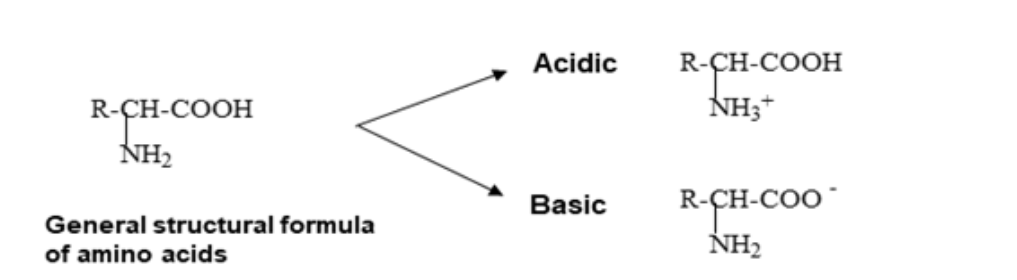
Since the TLC mobile phase is acidic, it results in the protonation of the NH2 functional group of primary amino acids by a hydrogen ion, resulting in a positively charged NH3+ group, as shown below.
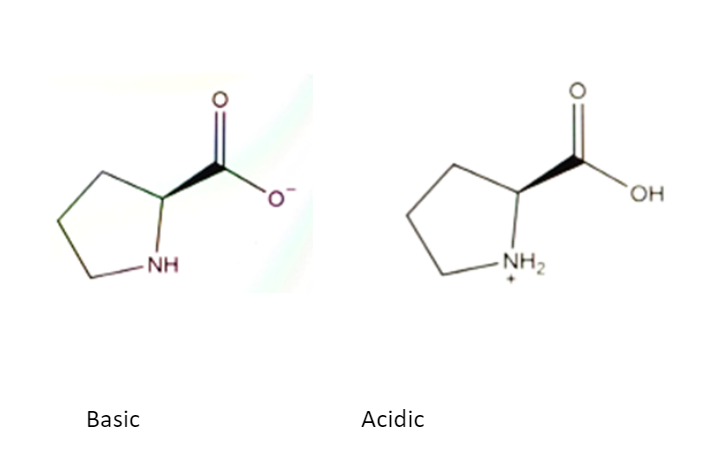
Whereas the NH functional group is protonated with secondary amines such as proline in acidic conditions to give a positively charged NH2+, as seen below.
Source: Butterworth Labs
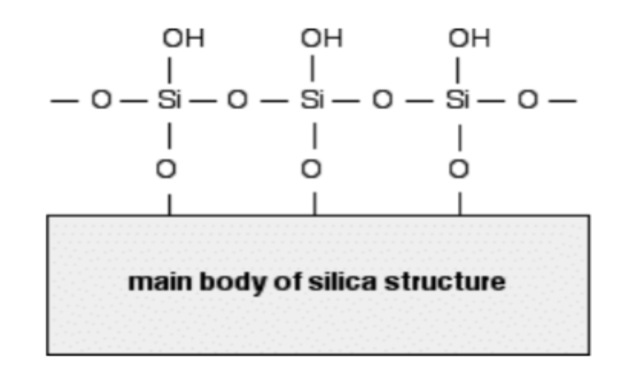
The structure of the silica gel plate’s stationary phase is illustrated below. Due to the electronegative oxygen atoms, the OH groups of the silica are partially negatively charged.
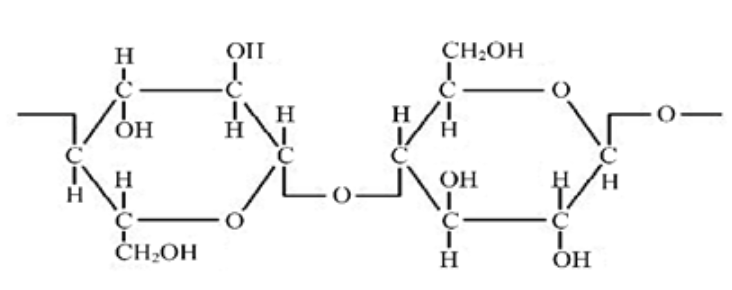
Similarly, with the structure of the cellulose stationary phase, the OH groups are partially negatively charged due to the electronegative oxygen atoms.
The positively charged NH3+ functional group of the protonated primary amino acids, or protonated NH2+ of secondary amino acids being carried up the TLC plate dissolved in the acidic mobile phase are attracted by the negative charge of the OH groups of the stationary phase, which slows the migration of the amino acids up the plate. The different R structures of specific amino acids affect the strength of, and therefore, the attraction of the positive charge of their NH3+ functional group to the negatively charged stationary phase of the TLC plate. This, along with their differing solubility in the mobile phase, results in specific amino acids travelling up the plate at different speeds resulting in the chromatographic separation.
After development, the TLC plate is dried in an oven, followed by applying the ninhydrin spray reagent and heat to the developed plate, which reacts with the separated amino acids, giving discreet coloured spots.
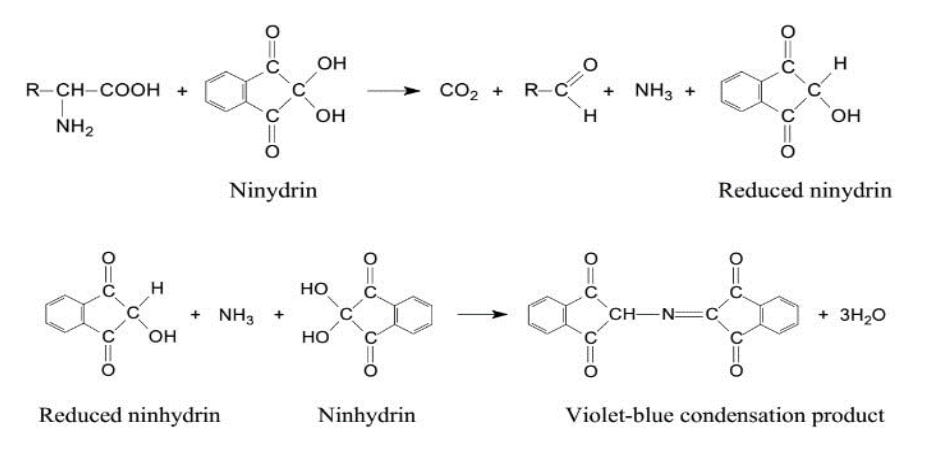
Most free amino acids contain a primary amine functional group. When derivatised with ninhydrin, this group gives compounds with a chromophore that absorbs electromagnetic radiation at 570nm, resulting in a violet-blue colour, as illustrated in the reaction mechanisms below.
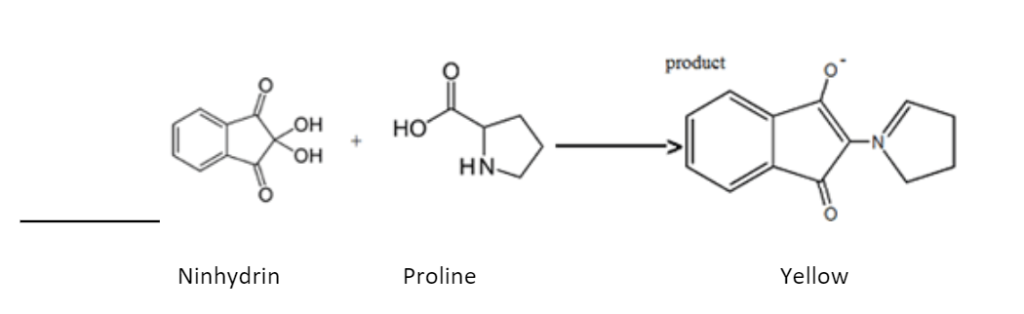
When derivatised with ninhydrin, amino acids with a secondary amine functional group, they produce products that absorb at 440nm and are yellow/orange.
The HPLC methodologies, adopted from 2013, are based on chromatographic separation by cation exchange with post-column ninhydrin derivatisation, resulting in the same coloured derivatives as with TLC, which are then amenable to dual-channel UV detection at 570 nm for primary amines and 440 nm for secondary amines. A lithium-based cation-exchange system gives the high resolution required for the analysis of physiological samples containing complex mixtures, including all classes of amino acids, and a lower resolution sodium-based system, which is adequately efficient and considerably faster for the analysis of the simple free amino acids included in PhEur monographs.
The HPLC columns used contain cation-exchange resin packing, generally in the form of small microbeads (0.25–1.43 mm radius) fabricated from an organic polymer substrate. The beads are typically porous (with a specific size distribution that will affect their properties), providing a large surface area on and inside them where the ion exchange process can take place. Most commercial resins are based on polystyrene sulfonate, as shown in the example below.
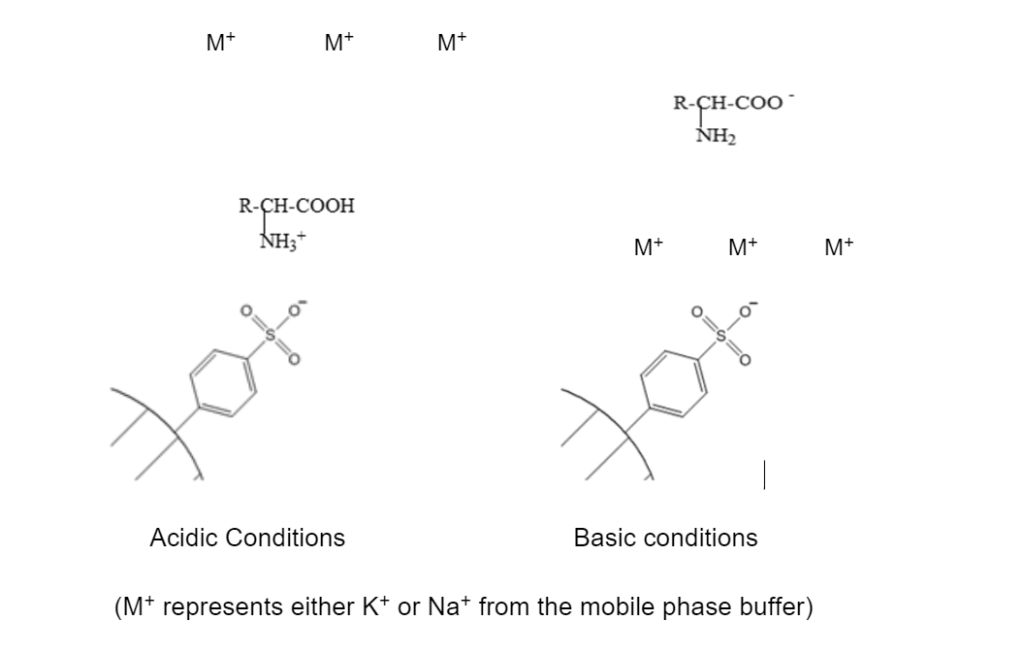
The aromatic sulfonate groups of the resin are strong enough acids that they are not protonated except under highly acidic pH values of < 1. Most of the analytical methods used for NPS analysis start with the mobile phase at pH 2 or 3, ensuring that the resin is negatively charged (SO3–). At this pH, the amino acid’s amine group (NH2) is protonated and positively charged (NH3+); thus, it will be attracted and bound to the negatively charged resin and will not progress through the HPLC column. As the analysis proceeds, the pH and ionic strength of the mobile phase buffer is progressively increased.
As the mobile phase becomes basic, the positively charged amino group is deprotonated, returning to the neutral state. At the same time, the carboxyl group (COOH) of the amino acid is also deprotonated and becomes negatively charged (COO–). This induces strong repulsion from the negatively charged resin, and the now negatively charged amino acid is released and replaced by M+ ions from the mobile phase as it progresses through the column. This replacement process is what gives the name ion-exchange. The exact nature of the R group of the different amino acids affects the precise pH and ionic strength at which ion exchange and release into the mobile phase will occur for each, which results in chromatographic resolution.
With secondary amines, the process is similar, with the protonation of their NH group to NH 2 + being responsible for attraction to the resin. At the end of each sample analysis, the column is washed by pumping a highly basic mobile phase solution of sodium hydroxide. This ensures that the column is stripped of all sample-related components in a process called regeneration. A relative 0.2% standard is prepared to analyse primary amine samples by diluting the sample solution. This standard is used to quantify other primary amine sample contaminants seen in the 570 nm UV detector channel. Secondary amine sample contaminants are quantified using an equivalent 0.2% standard of proline and responses seen in the 440 nm detector channel.
For analysis of secondary amine samples, a 0.2% standard of aniline is used for quantitation of primary amine contaminants using the 570 nm signal and a 0.2% dilution of the sample solution and the 440 nm detector channel is used for quantitation of secondary amine contaminants.
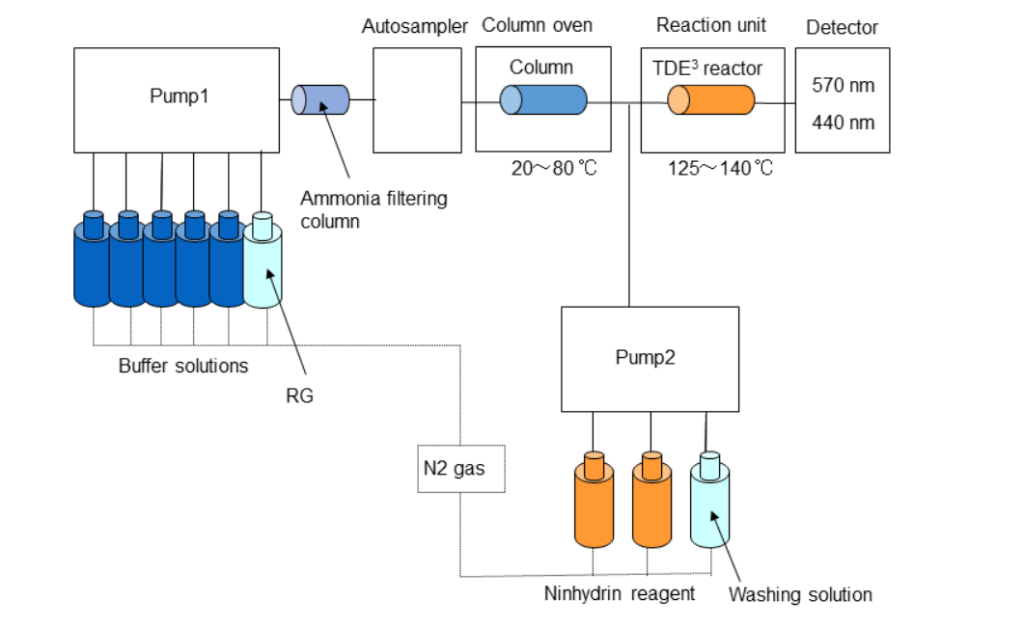
Below is a schematic showing a typical commercially available dedicated post-column ninhydrin HPLC amino acid analyser (AAA).
AAAs employ a mobile phase gradient proportioned from two to five individual buffer solutions depending on the specific system. The ninhydrin reagent is either a single solution that requires special storage conditions and has a short shelf-life or two solutions that are proportioned and mixed in real-time as needed by the system.
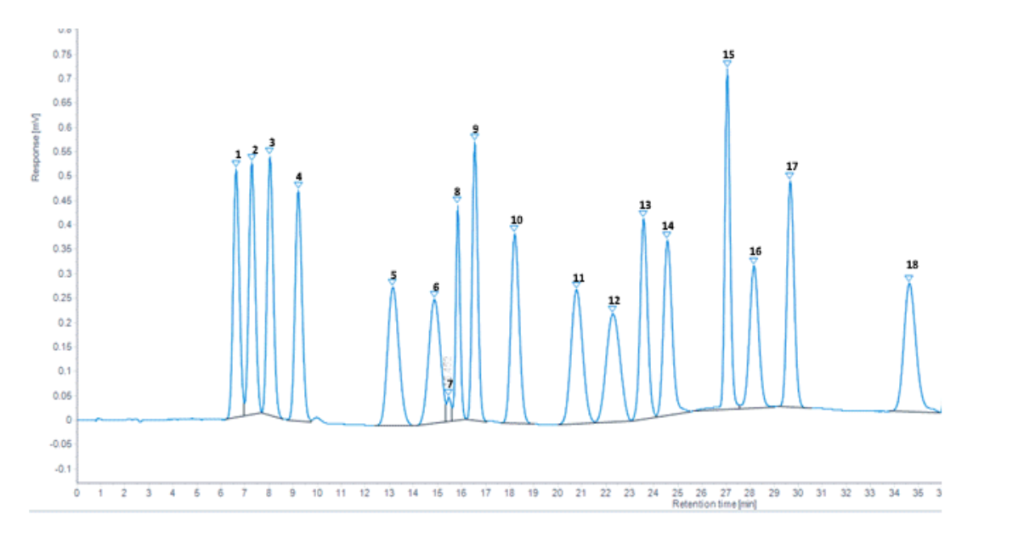
Below is a typical mixed primary amine standard chromatogram produced at Butterworth Laboratories Limited obtained with an AAA using five buffers and a two-part ninhydrin reagent conforming to the diagram above.
| Peak No. | Peak Identity | Peak No. | Peak Identity | Peak No. | Peak Identity |
| 1 | Aspartic Acid | 7 | Unknown | 13 | Tyrosine |
| 2 | Threonine | 8 | Cystine | 14 | Phenylalanine |
| 3 | Serine | 9 | Valine | 15 | Lysine |
| 4 | Glutamic Acid | 10 | Methionine | 16 | Ammonium |
| 5 | Glycine | 11 | iso-Lucine | 17 | Histidine |
| 6 | Alanine | 12 | Lucine | 18 | Arginine |
“In pharmacopoeial terms, the revision of individual amino acid monographs to replace the TLC NPS test with HPLC was carried out relatively quickly for the most relevant pharmaceutical raw materials once started,” says Judge. “Although the general monograph 2.2.56, published in 2004, was not prescribed for use by an amino acid monograph until 2013, between 2013 and 2017, 13 monographs were revised and, as at the time of producing this article, the number is 21.
“My thoughts are that the first two monographs to be revised were for leucine and isoleucine because these amino acids are difficult to resolve even by HPLC, and this resolution has subsequently been required as a demonstration of system suitability in all primary amine monographs that include the HPLC procedure.
“The PhEur amino acid monographs that have adopted HPLC to determine ninhydrin-positive substances still retain the TLC as one of the identification requirements and, therefore, are still relevant, which may be surprising. I think the TLC procedure remains to allow continued confirmation of identity using a simple test without the requirement for highly specialist AAA instrumentation. This facilitates inexpensive identity testing to be applied to individual containers of every batch of raw material used in production while using the HPLC method for testing fewer composite samples at the same time.”
Butterworth scientists see the fundamental challenges with the current TLC procedure as follows:
They see the advantages of the HPLC procedure as follows:
Reports that ninhydrin derivatisation is maintained in the HPLC procedures to give results comparable with those of TLC are not the case, says Judge, who concludes that it might have been better to replace TLC with a manual pre-column derivatisation procedure which could be accomplished using standard HPLC equipment rather than expensive and specialised AAA.
by John Welch
HFAs as a propellant in pMDIs for the treatment of asthma successfully addressed the problem of ozone depletion in the 1990s, but its contribution to global warming means it now must be phased out.
As the headlines about the climate emergency get ever more chilling, the propellants used in pressurised metered-dose inhalers (pMDI) for the treatment of asthma are once again under intense scrutiny. Frank Judge, consultant chemist at Butterworth Laboratories Limited, believes the industry is behind the curve in rolling out next-generation pMDIs that reflect the latest scientific understanding about the atmosphere and global warming.
Judge says: “Inhaler propellants have been in the spotlight since the late 1970s when the United States National Aeronautics and Space Administration (NASA), launched the Total Ozone Mapping Spectrometer (TOMS) mission aboard its Nimbus-7 satellite to study the concentration and distribution of global atmospheric ozone. The mission collected data from 1979 until 2004.(13,14) Environmental concerns have been the driving force of their evolution over the past decades.
“We are now at another turning point for pMDIs and the excipients they use for API delivery and it’s very likely that regulators step in and shorten the timeline for the phasing out of HFAs. Is the industry ready for this – and what will be the propellant of the future?”
The European Pharmacopoeia (Ph.Eur.) defines pressurised metered-dose preparations for inhalation as “solutions, suspensions or emulsions supplied in containers equipped with a metering valve and which are held under pressure with (a) suitable propellant(s), which can act also as a solvent.”
As a contract testing laboratory, Butterworth has extensive experience in the analysis of propellants with medical applications. Its scientists have been at the coal face of the regulatory changes impacting the industry that have come about as a result of greater awareness of the damage manmade pollution is causing to the climate and planet.
Judge says: “Before the late 1990s, pMDIs were almost exclusively manufactured using the CFCs CFC 11, CFC 12, and CFC 114,(8) and monographs for these were included in the major pharmacopoeias including the Ph.Eur.
“The benefits of these propellants were their physical and chemical characteristics including stability, low boiling point, low toxicity, and inert pharmacology. When first introduced for use, the CFCs underwent virtually no toxicological testing(9). They also readily dispersed or solubilised many active pharmaceutical ingredients (APIs).”
The Protocol led to increased use of hydrocarbons such as butane and iso-butane as propellants, in a variety of industries, however, these were not suitable for sensitive respiratory API delivery. The largest single application of pMDIs then, and continues to be, for the administration of the APIs, beclometasone, corticosteroid, salbutamol, salmeterol, budesonide, and formoterol, for the treatment of asthma. Drug formulations can include more than one of these actives, and are often accompanied by percent levels of ethanol to aid the solubility of the APIs.(9) The last CFC-driven pMDI sold in the UK contained a beclometasone-based formulation, manufactured by Teva and Neolab. This production finally ceased in 2010.(8)
The next step in the evolution of propellants used in pMDIs was the use of HFAs, an important development, Judge argues, as this class of propellants had many of the beneficial physical and chemical characteristics of CFCs but had no ozone-depleting potential. Studies of HFA 134a and HFA 227ea were carried out by the International Pharmaceutical Aerosol Consortium for Toxicity Testing (IPACT), which was comprised of the world’s major pMDI manufacturers.(3) These studies were carried out between 1990 and 1994.
“The only negative characteristics identified by the IPACT I & II studies were that, not surprisingly, both HFAs should be expected to lower the normal 100% oxygen levels in the lungs to a range of between 81% and 93% depending on the number of actuations administered, and also the physical characteristics of pMDI used (this had also been true of CFCs).(3) It was however found that both were pharmacologically active and could act as smooth muscle relaxants. These and all other fluorinated hydrocarbons when inhaled, have smooth muscle relaxant properties in the gut, vasculature, uterus, and lungs (bronchial smooth muscle) via calcium channel blocking, which is the end physiological response to HFAs resulting from their action on magnesium sulfate and beta2-agonists.(9)
“Dossiers resultant from the IPACT I and II studies were submitted to all of the major world health authorities including the European Health Authority Committee for Proprietary Medicinal Products (CPMP).”
In 1994 the CPMP ruled that HFA 134a could be a suitable alternative to the CFCs when demonstrated to comply with the approved quality specifications A year later, a similar conclusion from the CPMP followed regarding HFA 227ea.(3) Still, it would be many years before these HFAs would see use commercially in pMDIs for human use because of the requirement for toxicological testing to establish the compatibility and safety of each proposed API formulation in conjunction with its propellant, and the subsequent review and approval of each specific Drug Master File (DMF) by the CPMD.
In the case of HFA 227ea, the specification of Solvay (formerly Hoechst AG, now Daikin) was adopted and published by the CPMP since it had been the manufacturer and sole supplier of HFA 227ea used in IPACT II toxicological studies.(3) No monograph for HFA 227ea was published in the Ph.Eur. Solvay had submitted its DMF including its specification for HFA 227ea as part of the IPACT II dossier.(3) The generic names Apaflurane for HFA 227ea (1,1,1,2,3,3,3-Heptafluoropropane) and Norflurane for HFA 134a (1,1,1,2-Tetrafluoroethane) were adopted and used extensively from the late 1990s.
In 2016, Norflurane was the most extensively used propellant in the manufacture of pMDIs,(9) and its regulatory specification is defined in the current Ph.Eur. monograph no. 2257 for Norflurane (04/2013:2257 corrected 10.0). The 1990 IPACT I protocol for the toxicological testing of Norflurane had been incomplete and the anaesthetic activity of Norflurane was missed.(9) The Norflurane study in humans included inhalation in short doses at a maximum of only 0.8% in air.(9) For perspective, the highly active isoflurane is the most potent of the currently used inhalation anaesthetics, and a sustained level of 1.15% is required to render 50% of human subjects unconscious of pain.(11) Recreational abuse of pMDIs containing Norflurane became common, and it was reported that endurance Olympic athletes using Norflurane pMDIs had a performance advantage.(12) Toxicological testing in the UK now complies with the more stringent protocols of the Organisation for Economic Co-operation and Development (OECD), the International Conference on Harmonisation (ICH), and the European Chemicals Agency (ECHA) among others and it is unlikely that such anaesthetic activity would go unnoticed.
Judge says HFAs have defined our success in addressing the problem of ozone depletion but believes our current understanding of atmospheric science now poses an even more critical challenge, that of global warming. We must limit the expected rise in temperature caused by the emission of greenhouse gases to a maximum of 2°C, to avoid catastrophic world disasters. “This will require the ending of production and use of HFAs,” says Judge.
“While HFAs have zero ozone-depleting effect, they have a global warming potential (GWP) immensely greater than that of CO2. HFA 134a and HFA 227ea for example, have respectively 1,430 and 3,220 times the GWP of CO2 per metric ton of emission.(5)”
In 2016, the parties to the Montreal Protocol reached an agreement in Kigali, Rwanda to phase-down production and use HFAs. Countries agreed to add HFAs to the list of controlled substances and approved a protocol schedule for their reduction by 80% to 85% by the 2040s. The first reductions by developed countries has already begun. Some developing countries will freeze HFC consumption levels in 2024 and 2028. Under the Kigali Amendment, actions to limit the use of HFAs under the Montreal Protocol are expected to prevent the emissions of up to 105 billion tonnes of carbon dioxide equivalent of greenhouse gases, helping to avoid up to 0.5°C of global temperature rise by 2100, the single largest contribution the world has made towards keeping the global temperature rise below 2°C.(2)
The schedule of the Kigali Amendment may well be brought forward as new research reveals that human fossil fuel emissions are threatening to create the level of global warming years earlier than expected – and could see the world breach the critical 1.5°C number by 2029 rather than the mid-2030s as previously thought. So, what will come next?
Scientists at Butterworth propose hydrofluoroolefin HFO 1234ze(E) (1,3,3,3-Tetrafluoroprop-1-ene) could become the pMDI propellant of tomorrow.
“HFO is not ozone-depleting, has a global warming potential less than that of CO2, and has fewer physiological side effects than Norflurane,” says Judge, who worked at Huntingdon Life Sciences before joining Butterworth more than thirty years ago. Toxicological studies allowing the use of HFO 1234ze(E) in pMDIs have already been completed and approved by regulators in the UK, Europe and the USA and Judge urges the industry to start exploring next-generation pMDIs like Honeywell, Kindeva Drug Delivery, and AstraZeneca.
In November 2021, Kindeva Drug Delivery announced that it was installing a new pMDI line capable of filling HFO 1234ze(E) and that it expected to launch two products containing HFO 1234ze(E) by 2025.
Last February, Honeywell and AstraZeneca announced a joint venture reporting that Honeywell’s proprietary HFO 1234ze(E) ‘Solstice Air’, will be used in AstraZeneca’s next-generation pMDIs for the treatment of the respiratory conditions asthma and chronic obstructive pulmonary disease. Chiesi and Recipharm have also both reported that they expect to release pMDI products containing HFO 1234ze(E) before 2025.
Frank Judge worked as a scientist for Huntingdon Life Sciences in Suffolk, UK, before 30 years of service with Butterworth Laboratories Limited in Teddington, Middlesex, UK. He is a consultant chemist. This article has been written to provide a summary of the history of propellants used in pMDIs from the 1980s onwards, bringing together information from a variety of sources, gained from Butterworth’s experience of analysing the materials involved.
by John Welch
Helium is the second-most abundant element after hydrogen, created in stars by the process of nuclear fusion of hydrogen. In contrast, terrestrial helium is rare and is formed through the underground radioactive decay of uranium (238U). Over time, this helium migrates through permeable rock formations and is released into the atmosphere, where it is quickly lost into space.
Where the rock is impermeable, helium is trapped alongside methane natural gas deposits. Cryogenic high-pressure fractional distillation is used to extract the helium and nitrogen from the less volatile methane. This crude helium contains 50% to 70% helium and 1% to 3% residual methane, with the remainder mainly of nitrogen with a small amount of hydrogen. It is cooled to about -200°C and the resultant liquid methane and nitrogen are drained off. A small amount of air is added and the oxygen combines with the remaining hydrogen impurity by catalytic conversion to produce water vapour. The resultant gas is again cooled and the water is drained off.
Final trace impurities are then removed by pressure swing adsorption – a technique used to separate some gas species from a mixture of gases, typically air, under pressure – which renders ultra-high-purity analytical-grade helium.
Unfortunately, the decay of uranium has a half-life of 4.5 billion years, and therefore the geological formation of helium is negligible compared with the volume of human extraction. Helium is therefore considered to be non-renewable.
Helium crisis?
Are we on the cusp of a helium crisis? There are many examples of scientists predicting that global helium reserves will be depleted in 20 to 35 years but we don’t believe this is credible. The Mineral Commodities Summaries 2023, produced by the US Geological Survey, part of the US Department of the Interior, reports that global reserves of helium total 39,850,700 million cubic metres. The Geological Survey has very detailed accounts of reserves and production, but it does not give consumption figures. If we assume consumption is equivalent to the production of 160,000 million cubic metres, then reserves for 249 years are calculated (4). Based on 2019 data (1), supplies are adequate for an estimated 335 years,
The largest terrestrial helium reserves are in the US. In 2022, the US was responsible for 46.9% of global production (4). About 75% of this helium is extracted from natural gas of the Panhandle-Hugoton field, which straddles Texas, Oklahoma and Kansas. This natural gas is helium-rich, with an average concentration of 0.586% (2). Helium has been found in concentrations as high as 8% in some global sources of natural gas. In the US, the lowest practical helium concentration that can economically justify extraction is about 0.3% (3). Qatar is the second-largest producer, with 37.5% of global production in 2022. The US and Qatar together accounted for 84.4% of world production in 2022, followed by Algeria (5.6%), Russia (3.1%) and Australia (2.5%) (4).
According to many sources, we are still being affected by a helium shortage that began in 2019 as a result of the prolonged closure of the world’s largest purification facility in the US and critical maintenance at another two of the world’s eighth-largest purification plants. This became more pronounced in 2021 and 2022. The price of helium saw an increase of 300% between 2000 and 2020.
Changes to hardware required
Much helpful literature is available from instrument manufacturers about the changes to hardware and chromatographic conditions required when substituting helium with hydrogen as carrier gas. The manufacturer’s example chromatograms using hydrogen show complex sample components being beautifully resolved in less time than it takes to change a GC injection septa. This is great. In terms of the time taken for any particular GC analysis, hydrogen always produces the best results, but there are other considerations too.
The only unavoidable problem with the use of hydrogen is that it may react with some sample components during chromatography. This would be a significant worry if the aim of the analysis was the identification of unknown sample components. The concern with the flammability of hydrogen has largely been addressed by instrument manufacturers offering oven-leak sensors and gas-flow controllers that will shut off the gas flow if unexpected increases in flow due to back-pressure drops are noted.
Butterworth, like other laboratories, has decided to commission hydrogen generators, which will remove the safety risks associated with handling large gas cylinders, along with the cost and environmental impact of transporting them over long distances.
With Gas Chromatography – Mass Spectrometry (GCMS), there may be a requirement to use a modified ion source for best operation with hydrogen, and these are becoming available. When changing from helium to hydrogen, it is a relatively quick operation to change ion sources on modern instruments, and many do not require venting of the system vacuum to do so. The MS spectra obtained using hydrogen rather than helium may exhibit different ion fragment intensities from those of our current spectral libraries, which were produced using helium.
It is hoped that spectral libraries obtained using hydrogen will soon be available.. Specific detectors such as Electron Capture may not operate as effectively while using the required flow rate of hydrogen required for packed-column or mega-bore capillary analysis.
Regulatory compliance
When budding chromatographers ask me when the move to hydrogen will happen, my usual reply is “when the pharmacopeia says so”. The type of carrier gas is not an allowable adjustment in any of the pharmacopeia, and I believe the prescription of hydrogen in new and revised monographs will have more of an impact on the use of hydrogen than the price and supply of helium in the short term.
At present, and for the foreseeable future, helium, nitrogen and hydrogen will all be required as carrier gases, based on compliance requirements. There has been movement in the pharmacopeia; for example, in the revised USP Monograph for Castor Oil (2019), the determination of fatty acids has been changed from a titration to a GC assay using hydrogen as a carrier.
Indeed, there are now a number of methods in both the PhEur and USP requiring hydrogen, and so it looks like we are seeing the predicted shift starting to come into play. I think that for methods using nitrogen, there may be little sense in costly revalidation using hydrogen. A measure of the speed of historical updates to compendial methods can be seen in the number of monographs still requiring the use of packed columns and nitrogen carrier gas.
One point often misunderstood is that while hydrogen is a major step forward in terms of productivity, in terms of chromatographic efficiency (theoretical plates), nitrogen is surprisingly the best. For any given column, the carrier gas with the highest molecular weight will generate more theoretical plates because diffusion is minimised. Nitrogen gives about 15% more plates than hydrogen, the trade-off being that in order to achieve this, the run time would have to be 3.5 times that of hydrogen. The optimum nitrogen flow rate being 12cm/s, compared with 40cm/s for hydrogen, according to van Deemter curves.
Looking to the future
As protocols for the development and validation of chromatographic procedures for non-compendial APIs and raw materials are being agreed by the projects department, Butterworth is advising clients of the benefits of hydrogen, after taking into account concerns such as hydrogenation of sample components. In closing, and perhaps not least, the financial savings realised from a move from helium cylinders to hydrogen produced by in-situ generators is very significant and will have a real impact on analytical costs.
References
by John Welch
A string of fatalities linked to contaminated cough syrup in 2022 puts the spotlight on quality assurance in pharmaceutical manufacturing.
At the start of this year, the World Health Organisation (WHO) said that more than 300 children had died in The Gambia, Indonesia and Uzbekistan in 2022 in deaths linked to contaminated medicine. The medicines – over-the-counter cough syrup – were contaminated with ethylene glycol (EG) and diethylene glycol (DEG). These can cause acute kidney injuries and be fatal even when ingested in small amounts. Most of the children were under the age of 5.
To read the article published on Pharmaceutical Technology website in full, click here
To read our whitepaper titled ‘The Importance of Excipient Testing’. click here
by John Welch
In January 2022, the United Kingdom adopted ISO 10993-7:2008 / Amd 1:2019 as BS EN ISO 10993-7:2008 / A1:2022 without modification. The amendments include new allowable limits for neonates and infants. In the article written by Frank Judge, our Consultant Chemist Chromatography, he reviews to amendments to the previous version which is applicable to medical devices but not fabrics, drapes, contact lenses or some other particular devices such as dialysis blood flow components.
To read the article in full, click here
by John Welch
Butterworth have just completed the validation of an ICP-MS Method to show equivalence to Graphite Furnace Monograph tests for Lead, Cadmium and Nickel. ICP-MS analysis is routinely used to meet ICH Q3D requirements for Elemental Impurities in accordance with the Ph Eur and USP. It was a logical move to show the equivalence of this test to the established Graphite Furnace Atomic Absorption Spectroscopy (GFAAS) outlined in the monographs for Magnesium Stearate.
The reason for this methodology shift is prompted by a reduction in requests for analysis using GFAAS and AAS, especially following the introduction of ICP-MS in the Elemental Impurities general chapters. As such it is becoming harder for contact laboratories to justify the replacement of Atomic Absorption Spectrophotometers (AAS) as they come to the end of their life cycle.
There are already signs that the pharmacopoeias are replacing older metallic methodologies with elemental impurities analysis and this trend is likely to continue. Validation and verification will be something that outsourcers will need to consider as this change gathers pace. Butterworth are perfectly placed with the right experience and knowledge to help you get one step ahead and to provide more robust methodology.
For more information on this analysis: More information
by John Welch
Frank Judge has just published an article on the Pharmaceutical Technology website, which has been used to produce are latest Whitepaper. To download the whitepaper, see Whitepapers
Privacy Policy
Terms & Conditions
Accessibility Statement
Supplier Code of Conduct
Sitemap
Registered in England and Wales
Company Registration No: 1185121
In accordance with The Data Protection Act 1998, we are registered with the Information Commissioner’s Office under registration reference Z3601936.
| Cookie | Duration | Description |
|---|---|---|
| cookielawinfo-checkbox-analytics | 11 months | This cookie is set by GDPR Cookie Consent plugin. The cookie is used to store the user consent for the cookies in the category "Analytics". |
| cookielawinfo-checkbox-functional | 11 months | The cookie is set by GDPR cookie consent to record the user consent for the cookies in the category "Functional". |
| cookielawinfo-checkbox-necessary | 11 months | This cookie is set by GDPR Cookie Consent plugin. The cookies is used to store the user consent for the cookies in the category "Necessary". |
| cookielawinfo-checkbox-others | 11 months | This cookie is set by GDPR Cookie Consent plugin. The cookie is used to store the user consent for the cookies in the category "Other. |
| cookielawinfo-checkbox-performance | 11 months | This cookie is set by GDPR Cookie Consent plugin. The cookie is used to store the user consent for the cookies in the category "Performance". |
| viewed_cookie_policy | 11 months | The cookie is set by the GDPR Cookie Consent plugin and is used to store whether or not user has consented to the use of cookies. It does not store any personal data. |