For over 40 years, Butterworth Laboratories has provided independent, contract analytical services to the global pharmaceutical and related industries.
Safely Managing Highly Hazardous Reagents in Pharmacopeia Testing
23 February 2026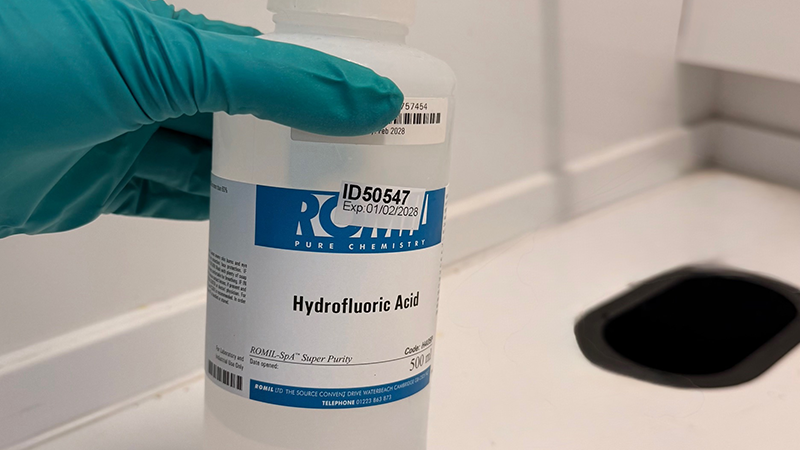
Expert Handling of the Most Challenging Reagents
Pharmacopoeia testing often requires the use of highly hazardous reagents such as hydrofluoric acid (HF) and the need to produce harmful gases such as hydrogen sulfide and chlorine. Fortunately, here at Butterworth Laboratories, we are fully equipped to safely handle these reagents and complete the necessary tests.
Technical Expertise in Hydrofluoric Acid Applications
Due to the ability of HF to quickly penetrate tissue, with potentially fatal consequences, its use is often limited. However, it can be a particularly useful reagent for materials such as SiO2, which are insoluble in water and other mineral acids. This means that assaying them by conventional methods is not possible. HF can be used to dissolve SiO2, and, following careful evaporation and ignition, the weight of the residue obtained can be used to accurately determine the assay content. In addition, HF is often used by our Metals Team for the determination of trace elements, as it is required for the dissolution of TiO2- and SiO2-containing materials. All of our ICP-MS and ICP-OES instruments can be fitted with PFA sample introduction kits to allow the testing of sample and standard solutions that contain HF. Our experience in both assay and trace metal analysis means we understand the precautions needed to avoid common pitfalls, such as contamination, through thorough cleaning processes.
Safety Infrastructure You Can Rely On
Here at Butterworth, our labs and analysts are fully prepared to handle HF with chemical-resistant lab coats, safety glasses and fume hoods as standard. In addition, specialist HF gloves with long breakthrough times are available, along with safe handling procedures and personal exposure monitoring. In the unlikely event of contact with HF, both Hexafluorine and Calcium Gluconate gels are available to remove and neutralise the acid, respectively, as well as Chemizorb powder to absorb and neutralise any spilt HF.
Controlled Generation and Management of Hazardous Gases
Several pharmacopoeia tests require the generation of hydrogen sulfide and chlorine gas; as with HF, our laboratories are fully equipped for the safe and controlled production, containment, and disposal of these chemicals. Chlorine gas is commonly used to produce chlorine water for tests such as bromide and iodide identification, whereas hydrogen sulfide can be used to identify antimony, bismuth, mercury, and zinc.
A Complete, Safe Solution for Monograph Testing
Butterworth Laboratories can offer a safe solution for handling the most hazardous reagents whilst simultaneously completing the remaining monograph tests for your convenience.
Meghann Simcock – Analytical Chemist at Butterworth Laboratories Ltd